




Summary
Studies on vitamin D and hair loss show that people with hair shedding are more likely to have low blood levels, but they do not prove that vitamin D regrows hair.
Vitamin D contributes to the normal function of the immune system, and large trials found a small drop in respiratory infections with daily doses. For mood, the results are mixed. A blood test is the best way to know if you are low.
Thinning hair, endless winter colds and a mood that dips with the light: vitamin D is often blamed for all three. This guide looks at what the research on vitamin D and hair loss, mood and immunity really shows, and where the evidence stops.
| At a glance | Vitamin D |
|---|---|
| Main source | Skin exposed to summer sunlight; smaller amounts in oily fish and egg yolk |
| Supplement forms | Vitamin D3 (cholecalciferol) and vitamin D2 (ergocalciferol) |
| EU daily reference value (NRV) | 5 µg (200 IU) |
| EFSA upper limit for adults | 100 µg (4000 IU) a day |
| Authorised role | Contributes to the normal function of the immune system |
| Blood marker | 25 hydroxyvitamin D, often written 25(OH)D |
Vitamin D and hair loss, mood and immunity: why the link?
Vitamin D acts more like a hormone than a typical vitamin. Its receptors are found in hair follicles, immune cells and the brain.
It also contributes to the maintenance of normal bones, muscle function and teeth.
Who tends to run low on vitamin D?
- People who spend most daylight hours indoors, such as office and shift workers.
- Anyone living far from the equator, where winter sunlight is too weak for the skin to make vitamin D.
- Older adults, because the skin makes less vitamin D with age.
- People with darker skin or who cover most of their skin outdoors.
For a northern view, read our Nordic winter vitamin D guide.
Vitamin D and hair loss: what the studies found
Non scarring hair loss (2023, Journal of Cosmetic Dermatology). This meta analysis pooled 23 studies with 3,374 people with hair loss, including alopecia areata, pattern hair loss and telogen effluvium, and 7,296 healthy controls. People with hair loss had lower vitamin D levels and were about three times more likely to be deficient.
Across 23 studies, people with common types of hair loss were about three times more likely to have low vitamin D than people without it.
These observational studies show a link, not cause and effect, and few trials have tested whether supplements change hair growth. If you are shedding hair, checking vitamin D alongside iron and zinc makes sense; see our guide to iron and hair loss and zinc for hair loss, skin and acne.
Vitamin D and immunity: the large trials
Individual data from 25 trials (2017, BMJ). Across 11,321 participants aged 0 to 95, people given vitamin D were less likely to have at least one acute respiratory infection. The benefit came from daily or weekly doses, not occasional large ones, and was strongest in people starting below 25 nmol/L.
Update of 46 trials (2021, Lancet Diabetes and Endocrinology). With 48,488 participants analysed, the overall effect was still present but small: 61.3% of the vitamin D group had at least one respiratory infection, against 62.3% on placebo. Daily doses of 400 to 1000 IU (10 to 25 µg) taken for up to 12 months showed the clearest benefit.
Vitamin D and mood
Meta analysis of 41 trials (2022, Critical Reviews in Food Science and Nutrition). Across 53,235 adults, vitamin D was linked to a reduction in depressive symptoms, especially at 2000 IU (50 µg) a day or more. The authors rated the certainty of this evidence as very low because the trials differed widely.
VITAL depression study (2020, JAMA). In 18,353 adults aged 50 and over without depression at the start, 2000 IU of vitamin D3 a day for a median of 5.3 years did not change the risk of depression or mood scores compared with placebo.
Vitamin D does not appear to lift mood in people who are already well, and it is not a treatment for depression. If low mood lasts more than two weeks, speak to your doctor. For winter sleep and the dark season, see our guide to sleep in the dark season.
| Study | Who | Design | Main finding |
|---|---|---|---|
| Chen, 2023 | 3,374 people with hair loss | Meta analysis of 23 studies | Lower vitamin D levels than controls |
| Martineau, 2017 | 11,321 people aged 0 to 95 | Data from 25 trials | Fewer respiratory infections, mainly with daily or weekly doses |
| Jolliffe, 2021 | 48,488 people | Meta analysis of 46 trials | Small overall benefit; clearest with daily 10 to 25 µg |
| Mikola, 2022 | 53,235 adults | Meta analysis of 41 trials | Fewer depressive symptoms; very low certainty |
| Okereke, 2020 | 18,353 adults aged 50 and over | Randomised trial, 5.3 years | No change in depression risk or mood |
How much vitamin D do adults need?
- Daily reference value: 5 µg on EU labels; the trials above used daily doses of 10 to 50 µg.
- Upper limit: EFSA sets 100 µg a day for adults from all sources.
- Daily beats occasional: trials favoured steady daily or weekly intake over large single doses.
- With food: vitamin D is fat soluble, so take it with a meal.
For amounts suited to life in Greece, read our vitamin D dosage guide for adults in Greece.
Is vitamin D safe?
- Very high intakes over time can raise blood calcium, causing nausea, thirst and kidney strain.
- Check with your doctor if you have kidney disease, sarcoidosis or high calcium, or take thiazide diuretics or digoxin.
- A 25(OH)D blood test is the only reliable way to know your level.
Vitamin D in FOOON VIT & MIN + CoQ10
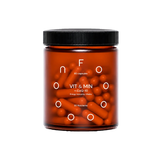
VIT & MIN + CoQ10 includes vitamin D3 alongside vitamin K2, zinc, iron as ferrous bisglycinate, vitamin B12, folic acid and coenzyme Q10, with the other ingredients listed on the label. The directions are up to 2 capsules a day with water after your main meal, which suits a fat soluble vitamin. It is manufactured in Greece under GMP. Count other vitamin D supplements so your total stays below the EFSA limit.
Frequently asked questions
Can low vitamin D cause hair loss?
People with hair loss are more likely to have low levels, but studies have not proven that low vitamin D causes it.
Will vitamin D make my hair grow back?
There is little trial evidence that vitamin D regrows hair. Correcting a proven deficiency is sensible, but see a dermatologist for ongoing hair loss.
Does vitamin D help with colds?
Vitamin D contributes to the normal function of the immune system. Large trial analyses found slightly fewer respiratory infections with daily doses, mostly in people who were low.
Can vitamin D improve my mood?
Results are mixed. A large five year trial found no effect in healthy older adults. Persistent low mood needs a doctor's assessment.
How much vitamin D is too much?
EFSA sets the adult upper limit at 100 µg (4000 IU) a day from all sources combined.
When is the best time to take vitamin D?
With a meal that contains some fat, at a time you will remember every day.
Bottom line
The research on vitamin D and hair loss shows a clear link with low levels but no proof that supplements regrow hair. Vitamin D contributes to the normal function of the immune system, and daily doses were linked to slightly fewer respiratory infections. For mood, the evidence is weak. Test your level, aim for steady daily intake and stay below 100 µg a day.
Explore VIT & MIN + CoQ10 →Related reading: SOMA
Sources
- Chen Y, Dong X, Wang Y, Li Y, Xiong L, Li L. Serum 25-hydroxyvitamin D in non-scarring alopecia: A systematic review and meta-analysis. Journal of Cosmetic Dermatology. 2023;23(4):1131-1140. PMID 38010941. doi.org/10.1111/jocd.16093
- Martineau AR, Jolliffe DA, Hooper RL, et al. Vitamin D supplementation to prevent acute respiratory tract infections: systematic review and meta-analysis of individual participant data. BMJ. 2017;356:i6583. PMID 28202713. doi.org/10.1136/bmj.i6583
- Jolliffe DA, Camargo CA, Sluyter JD, et al. Vitamin D supplementation to prevent acute respiratory infections: a systematic review and meta-analysis of aggregate data from randomised controlled trials. Lancet Diabetes and Endocrinology. 2021;9(5):276-292. PMID 33798465. doi.org/10.1016/S2213-8587(21)00051-6
- Mikola T, Marx W, Lane MM, et al. The effect of vitamin D supplementation on depressive symptoms in adults: A systematic review and meta-analysis of randomized controlled trials. Critical Reviews in Food Science and Nutrition. 2022;63(33):11784-11801. PMID 35816192. doi.org/10.1080/10408398.2022.2096560
- Okereke OI, Reynolds CF, Mischoulon D, et al. Effect of Long-term Vitamin D3 Supplementation vs Placebo on Risk of Depression or Clinically Relevant Depressive Symptoms and on Change in Mood Scores: A Randomized Clinical Trial. JAMA. 2020;324(5):471-480. PMID 32749491. doi.org/10.1001/jama.2020.10224
- European Food Safety Authority. Overview on Tolerable Upper Intake Levels as derived by the Scientific Committee on Food (SCF) and the EFSA Panel on Dietetic Products, Nutrition and Allergies (NDA). Version 11, August 2025. efsa.europa.eu
- Regulation (EU) No 1169/2011 on the provision of food information to consumers, Annex XIII (nutrient reference values). eur-lex.europa.eu


